In our article series Eco HomeLife Explains we try to bring you interesting, short explanations of sustainability topics. In this edition, we ask: is buying second-hand better for the environment?
Many people see second-hand items as a sustainable alternative to buying new. Second-hand clothing is especially popular, because of the possibility to pick up a unique piece or a bargain without the environmental impact.
But is buying second-hand more sustainable? Yes, is the short answer, but there is a caveat. So let’s dive into it…
The Environmental Benefits Of Buying Second-Hand
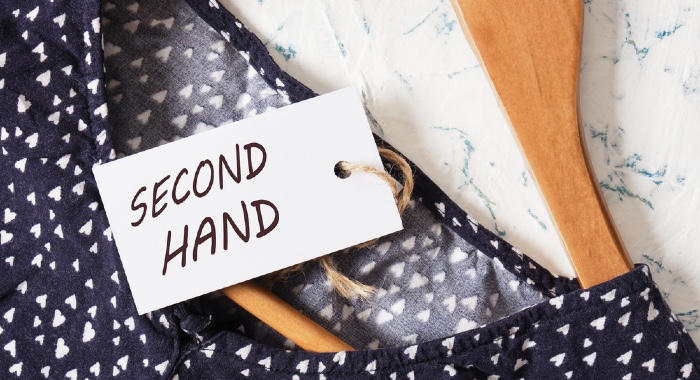
As we have already said, it is more sustainable to buy second-hand. The consumption of second-hand items compared to new items has several positive impacts on our planet:
- Decreased demand on resources
- Reduction of waste
- Fewer greenhouse gas emissions
- Avoiding pollution
Focussing on the fashion industry, a study has shown that buying a second-hand garment instead of a new one can reduce its climate change impact by 26% to 42%, its demand on energy by 27% to 42%, its freshwater pollution by 42% to 53% and its water scarcity footprint by 35% to 53%. (Klooster et al., 2024)
Let’s look at each of the above benefits in detail.
Decreased Demand On Resources
When a new product is made, the first thing that is needed is the material. For example, to make a garment you need fabric, to make furniture you need wood/plastic/metal and to make a silver earring you need silver.
All of these materials come from some natural resource, such as timber, metal ore, fossil fuels. Demand on these resources is continuously rising. According to the UN, the extraction of resources has increased more than threefold since the 1970s.
An increase on demand puts pressure on ecosystem through deforestation, biodiversity loss, habitat degradation, pollution, greenhouse gas emissions and with that, global warming and climate change. (Adejumo 2020)
By buying second-hand, we can contribute to decreasing the demand on resources, because it will lower the demand for new goods. Think about it, for every piece of pre-owned furniture, pre-loved garment, second-hand gadget you buy, the demand for a new garment, furniture or gadget will drop.
Of course, in order to be impactful, the switch to being pre-owned needs to be consistent and sustained. So buying one second-hand dress will only have a minimal impact. But if you consider opting for pre-loved items as much as possible, you can make a meaningful difference for our environment.
And there are so many things you can buy second-hand, including clothes, furniture, ornaments, gadgets, electrical appliances, tools, equipment, etc.
Waste Reduction
There is no denying that we have a waste problem. According to the UN, we produce over 2 billion tonnes of waste every year. If the current trends continue, they estimate that this will increase to 3.8 billion tonnes by 2050.
And with only 60% of this waste being properly managed in controlled facilities worldwide, the environmental impact is huge.
If we continue to produce waste at the current rate, more and more land is needed for landfill facilities. This means loss of habitats and biodiversity loss, which are a driver for climate change.
Second-hand shopping is part of a circular economy where items don’t get thrown away but kept in the circle by recycling, repurposing or reusing. When you buy something pre-owned you give it another lease of life and keep it out of landfill.
It also prevents unnecessary waste, because the item wasn’t needed or wanted anymore by the previous owner. But instead of throwing it away, they decided to let someone else use it instead.
We throw away so many things that are still usable or could be repaired, and with that creating unnecessary waste. This is especially true when it comes to textile waste, where many throw away things that are no longer in fashion or fit their owner’s style or size.
So rather than binning this pair of jeans that no longer fits you, sell it on, or donate it to a charity shop and keep it out of landfill. Selling and buying unwanted items is a great way to reduce waste.
Lower Greenhouse Gas Emissions

Making new things creates a lot of greenhouse gas (GHG) emissions. According to the UN, manufacturing steel, iron, clothes, plastic, electronics and everything else releases greenhouse gas emissions, mostly through the burning of fossil fuels during the manufacturing processes.
The industry sector was responsible for 24% of global greenhouse gas emissions in 2019. (Bashmakov et al., 2022) If demand for new items is high, the sector will continue to produce huge a mounts of GHG emissions.
By buying second-hand, we can reduce the demand and with that the harmful emissions. For example, buying refurbished furniture instead of new can reduce the emissions by 85%, according to the University of Michigan.
Reducing greenhouse gas emissions is vital, if we want to meet the target set out in the Paris Agreement and prevent a climate catastrophe.
And buying preloved items is one way to achieve this.
Preventing Pollution
Manufacturing goods contributes to air, soil and water pollution. It starts with the extraction from raw materials, such as metals. Mining has a huge environmental impact, including causing pollution. (Dehkordi et al., 2024)
Other materials, such as petrochemicals are made from fossil fuels in labs using chemical processes. These are then used to make ingredients for all sorts of goods, such as cleaning products, personal care products, makeup, etc.
Petrochemicals are also used to make plastic, one of the most ubiquitous human-made material in our world.
Manufacturing these petrochemicals causes air, water, and soil pollution, according to a very interesting article from the University of Columbia.
But it doesn’t stop there. When used or disposed of, the pollution continues. Think of cleaning products, laundry products, shampoos, shower gels, etc., that end up flowing down the drain. They reach the environment, where they pollute the various ecosystems.
If you think of the fashion industry, every time an item of clothing made of artificial fabrics is washed, during production or at home, it releases microplastics in the form of microfibres, which pollute our waters, soil and air.
But if we buy second-hand goods, we reduce the demand for new goods to be made, which will reduce the amount of pollution caused during their production.
But Shifting To Second-Hand Buying Alone Isn’t Enough

Second-hand shopping is definitely beneficial to reduce environmental harm, as we have seen. However, studies have shown that it doesn’t solve the underlying issue, in fact, it can actually make it worse.
A study has shown that young people in the US who bought second-hand clothes, also bought new garments, so rather than replacing new items the preowned clothes were bought in addition. (Mizrachi and Sharon, 2025)
Furthermore, the same study reported that people buying second-hand clothing were producing more waste. They disposed of still usable garments quicker than people who only buy new ones.
This shows that buying second-hand doesn’t prevent overconsumption, it can even make it worse. So what has to come first is a move to sustainable consumption. This means, we only buy what we need.
If you want to know how you can achieve sustainable consumption in your life, read our article about how to become a conscious consumer.
Combining sustainable consumption levels with second-hand shopping as much as possible is the best way to avoid environmental damage.
So before you head to your closest next second-hand shop, ask yourself, do you really need what you want to buy?