If you are considering switching from a liquid shampoo to a solid one, you might have heard some horror stories and now wonder: are shampoo bars bad for your hair?
When I first decided to reduce my plastic waste and looked into swapping my normal shampoo for a shampoo bar, many people told me not to do it, as it would ruin my hair.
Some told me that these bars are just soaps and that they will dry out my hair. Others said my hair would fall out.
A bit apprehensive, I decided to do some research and find out if all these stories are true.
In this article, I will share my findings with you and answer the question: are shampoo bars bad for you?
What Is A Shampoo Bar?
One thing I heard a lot was that these shampoo bars are actually just soaps and companies just try to make more money by selling them as shampoo. That’s why I understand why many people ask: are shampoo bars bad for your hair?
So I set about to find out if this is true and the answer is: no.
Shampoo bars are basically the concentrated form of liquid shampoos. The same ingredients (well almost, we talk about that a bit later) but 80% less water.
So they are designed for your hair and are not just soap bars that have been given a new name.
However, there are two types of shampoo bars:
- soap-based
- surfactant-based
The difference between them is on one side the ingredients and on the other side the way they are produced.
Find Out Which Shampoo Bar Brand Is Best For You
Answer 5 simple questions and get a personal recommendation:
Soap-Based Shampoo Bars

I know what you are thinking, so they are soaps after all. Well, they are made by using the same process as soap. This process is called saponification.
And technically that makes them soaps, but they have still been made for your hair, rather than for your hands like soap bars we are used to.
The difference between a soap bar and a soap-based shampoo bar is that the latter is made with more oils and butters, normally plant derived. Shea butter and coconut oil are two of the most used ingredients for soap-based shampoo bars.
So in chemical terms this type of solid shampoo is a bar of soap, but it is nonetheless made specifically for your hair.
Soap-based shampoo bars are made with natural ingredients, mostly oils and plant butters, which are used as the cleaning agents. Here are some examples you might see on the ingredients list:
- sodium hydroxide
- sodium olivate
- sodium shea butterate
- sodium cocoate
This means soap-based bars are natural shampoo bars that don’t use any chemicals.
While it is great to use a product that uses only natural ingredients, there are some drawbacks:
- If you have never used soap-based shampoo bars, you are likely to have to go through a transition period, which can take days, weeks or even months.
- Soap-based shampoo bars and hard water don’t go well together, and you might have to do regular acid rinses to make it work.
- Because there are no foaming agents in this type of shampoo bar, it won’t lather up as well as others, which means it will take a bit longer to wash it out.
As I live in a very hard water area, I decided not to use soap-based shampoos. But that does not mean that they are no good.
I would still answer no to the question “are shampoo bars bad for your hair?” if we are talking about soap-based ones.
It’s just that this type of solid shampoo is not for everyone. I would recommend it to people who:
- live in a soft water area and want to use products with natural ingredients
- have sensitive skin which gets irritated by commercial liquid shampoos
- people who want to switch to products with natural ingredients and who are willing to go through a transition period and accept that if they live in a hard water area they have to adapt their hair washing routine
Surfactant-Based Shampoo Bars

The second type of shampoo bar are surfactant-based. This means they don’t go through the saponification process and are therefore soap-free.
Instead, they are made like liquid shampoos, but without all the water, which means they are the concentrated form of commercial shampoos.
That said, solid shampoo bars tend to use more natural ingredients than most commercial shampoos.
That includes the surfactants that they use. These are foaming and cleaning agents that ensure that the shampoo bar lathers up well, and that it removes all the dirt.
Commercial shampoos use a surfactant called sodium lauryl sulphate (SLS) and it’s used because it is effective and easy and cheap to produce.
This ingredient has a bad name, because it is a synthetic substance that is commonly made from petrol and therefore seen as not environmentally friendly.
It can also cause irritation as it is a very effective detergent, which is another reason why many people reject products with this ingredient.

That’s why many shampoo bars don’t contain this ingredient or its close relative sodium laureth sulphate (SLES). In their place they use naturally derived alternatives, which are still effective cleaning and foaming agents, but they are plant derived and less harsh on the skin.
One such alternative is sodium coco sulphate (SCS), which is plant-derived, mostly from coconut oil. Although this alternative is milder, it is still a sulphate and as such there are drawbacks with this ingredient:
- Sulphates, however mild, can cause skin irritations, especially for people with a sensitive scalp or skin.
- Sulphates are so effective in cleaning away dirt and oil, that they strip the hair of essential natural oils and moisture.
Are shampoo bars bad for your hair if they contain sulphates? No, they are still safe to use, but they are very effective cleaning agents that could irritate your skin, depending on how harsh they are and how sensitive your skin is.
If you want to go sulphate-free, but not soap-based, you can choose shampoo bars that use ingredients that are surfactants but not sulphates. These are all milder and plant-derived, so produce natural shampoo bars.
Examples of these non-sulphates surfactants are:
- sodium cocoyl isethionate
- disodium lauryl sulfosuccinate
- soidum lauryl sulfoacetate
- decyl glucoside
- coco glucoside
While it is a question of preference and everyone has to make their own decision, some people might be better off choosing a surfactant-based shampoo bar, if:
- they live in a hard water area, as it will make life so much easier
- they don’t want to go through a transition period
I am one of those people, as I live in a very hard water area and therefore opted for surfactant-based shampoo bars.
Our Top-Rated Surfactant-Based Shampoo Bars:
| Shampoo Bar | Value For Money | Range | Results | My Rating | Review | Website |
|---|---|---|---|---|---|---|
 | Excellent | Great | Outstanding | 4.90 | Review | Visit |
 | Outstanding | Good | Excellent | 4.90 | Review | Visit |
 | Excellent | Great | Outstanding | 4.90 | Review | Visit |
Crunch Time

Okay, so now that we know all about shampoo bars, let’s look at our question again: Are shampoo bars bad for your hair?
The answer is no. In fact, most shampoo bars are probably better for your hair than the majority of liquid shampoos, because they use more natural and less harsh ingredients.
Shampoo bars also tend to be free of silicone, parabens, synthetic fragrance and other nasty chemicals.
As a result, rather than causing damage, solid shampoos are more likely to improve the health of your hair. So my answer to the question “are shampoo bars bad for your hair?” is emphatically no.
I have found that I don’t need to use a conditioner anymore, since I swapped from a liquid to a solid shampoo.
Therefore, it’s just a question of finding the right type of shampoo bar for you.
You may have to experiment with different types and different brands, but you will find one that works for you.
And there are shampoo bars for every hair type. No matter if you have thick hair, curly hair, dry hair, thin hair or sensitive skin, there will be a shampoo bar for you.
Recommendations
Now that we have answered the question “are shampoo bars bad for your hair?”, you probably are keen to start your journey from liquid to solid shampoo.
After all, we know that the environment is in a disastrous state, and we all need to make changes. Reducing plastic waste is one easy thing to do.
By swapping to a solid shampoo bar, you could save two plastic bottles. Now that sounds like a great thing to me.
To help you along, I share the experiences I had in my journey from liquid to solid shampoo.
Because I live in a very hard water area, I decided to go for surfactant-based shampoo bars, so all of my recommendations are soap-free bars.
KinKind

I really like this brand, because it’s a family-run UK business that manufactures all their products right here in the UK. This means they are keeping their carbon footprint low.
KinKind was born from a wish to reduce plastic waste in their own household. Now they aim at eliminating the use of plastic bottles in households around the UK.
Their shampoo bars contain plant-derived ingredients and are free of SLS, paraben and silicone.
The surfactant they use is sodium coco sulphate, which, as we have already seen, is a milder cleaning and foaming agent.
I tried their NOURISH me! shampoo bar, which nourishes and moisturises the hair with coconut oil. My hair was super soft and smelled heavenly of coconut after using the bar.
Because the bar contained a sulphate, I also used the corresponding conditioner bar, which made my hair very easy to brush. However, I will try the shampoo bar on its own, to see if I still need the conditioner, given that KinKind uses no nasty chemicals such as paraben.
I will update this article once I have the results.
As expected, the shampoo bar lathered up brilliantly and my hair was squeaky clean after the wash. And there was no transition period or problems with my hard water.
Just an easy and hassle-free swap from liquid to solid shampoo, and you reduce your plastic waste.
You can read all about my full experience with this product in my KinKind shampoo bar review.
Faith In Nature
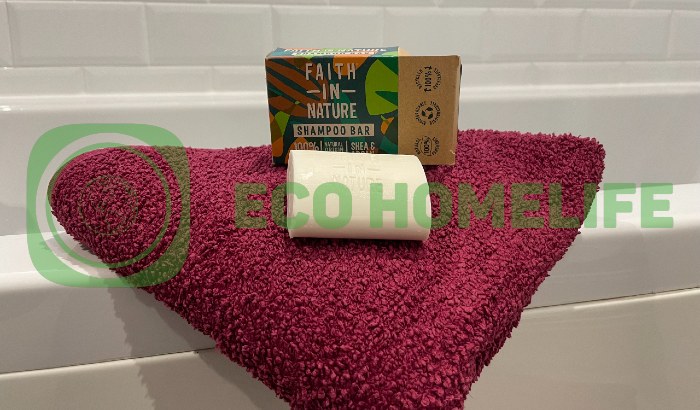
Another family-run UK company that produces all their shampoo bars in the UK. I really like that they put nature first in all the decisions they make.
This means Faith In Nature puts a lot of emphasis on producing sustainable products that will not harm the environment. And that’s something I can get wholeheartedly behind!
Their shampoo bars are sulphate-free. Instead, they use sodium cocoyl isethionate and disodium lauryl sulfosucciante as cleansing and foaming agents, both plant derived.
These sulphate alternatives are much milder and won’t strip your hair of oil and moisture. After using their shampoo bar I didn’t need to use a conditioner, which was a first for me.
Admittedly, the shampoo bar did not lather up as much as the KinKind one, but it was still enough to get a lovely foam all over my thick hair. And it cleaned my hair as well as any liquid shampoo without the harsh detergents.
Again, there was no transition period, and it worked well with my hard water.
After my hair was dry, it was soft and looked healthy and shiny. Unfortunately, it didn’t smell as much as I hoped, but I guess that’s just a sign that they don’t use any synthetic perfumes, like liquid shampoo producers do.
Read more about my experience with this brand in my Faith In Nature shampoo bar review.
Now that you have the answer to the question: are shampoo bars bad for your hair, you can confidently make the swap away from shampoos in plastic bottles to solid ones and make a positive change for the environment.
If you want to know more about hair care and the envrionment, read our article about why conventional shampoo is bad bad for the environment.